Improve — a word to the wise

Photo by Denise Jans on Unsplash

My dispute with the word improve began some years ago when writing for a software company. It’s a tough one in the tech world because I’d say that improvement lies at the core of technology. Tech companies constantly make improvements to their products, making them faster, more widely accessible, reducing environmental impact, and so on. 

In my mind, improvement is fundamentally about change. To make an improvement, you must change something. You might, for example, change the chipset your product runs on, use different materials, or rewrite a piece of code to take advantage of new hardware technologies. For readers, I believe that understanding what has changed allows them to infer improvement — instead of me telling them what has improved because what I think is an improvement may not hold for somebody else. 

A former colleague of mine once said we could improve the office environment by having a Starbucks machine in the reception. I believed she had a point, but mainly because the coffee in our office at the time was atrocious — but that’s my opinion based on my preferences. Not everyone approves of the great coffee giant and its promotion of single-use cups. In such cases, it’s better to talk about the change and leave it up to the reader to decide if an improvement has been made. And if your case is strong, the likelihood that your customers will believe you’ve made an improvement will be significant.

To test the validity of improve in my copy, I have developed a test: is there enough context for the reader to understand what has changed, and if so, do I need to use the word improve at all, or can I simply talk about the change — is the use case strong enough?

Going back to my time at the software company, we had a lot of different products, and one of my responsibilities was to write the release notes for each new version. Today, the mere mention of release notes will send me running for the hills, hoping never to return. The problem is that release notes are a sweet spot — or, in my opinion, a sour spot. They bring engineering, marketing, tech writers, product managers, and leadership (mainly the CTO) together — which is a recipe for disaster because everyone has a different agenda. 

Depending on the size of the release, the notes will include three elements: new features, enhancements, and bug corrections. The problem usually arrives in that last section because writing about new features and enhancements tends to align with the needs of all stakeholders — including customers. However, when it comes to explaining bug corrections, the heat turns up — and I think it’s due to that agenda misalignment. 

The CTO wants to ensure that anything we write about a bug fix doesn’t have damning implications for the company. The marketeers want to ensure that customers understand the value of the changes that have been made. Product managers want to make sure that their product image remains intact. The tech writers are concerned with making sure that what they write is understandable to the target audience and accurately reflects the change. And the engineers don’t want to lose face by admitting their code has flaws.

But what has all this got to do with the word improve? When I’d receive content from engineering about changes, bug corrections tended to be an endless list of improvements. And I’d be like, what does that mean, improve? How did you improve it? What was wrong in the first place? 

My main objection to this word is its lack of specificity. It would help if you quantified the improvement. Otherwise, you’re leaving yourself wide open to interpretation. 

Imagine a software add-on called ‘the accelerator,’ enabling clients to process ten times the number of transactions per second. We’ve received a bug report about the add-on that the engineers have resolved. For the release notes, the engineers gave me this: we improved the accelerator. 

I now want to put my sneakers on and run. Depending on a customer’s specific experience with the accelerator, this sentence will likely raise more questions. 

In such cases, I would go to the engineering team to ask some more questions. On the rare occasion that an engineer decided I was worthy of their time, the conversation might go something like this:

Me: How did you improve it? 

Engineer: You don’t need to understand that we just fixed something that wasn’t working, and now it works. 

Me: What wasn’t working? 

Engineer: It’s complicated (while staring out the window). 

Me: Try me.

Engineer: Our accelerator wasn’t working for some of our customers. 

Me: What wasn’t working? 

Engineer: It was slow in some environments.

Me: What do you mean by slow? 

Engineer: We have this one customer who reported the bug. When they implemented the accelerator, they didn’t see any increase in the number of transactions being processed.

Me: Oh dear. And will they experience a 10% increase with this latest release?  

Engineer: Yes. 

Me: So, what did you do?  

Engineer: When we looked into it, we saw that this customer was running many tasks on the same VM, and our accelerator wasn’t getting any compute power. 

Me: So, nothing wrong with the accelerator? 

Engineer: Well, no, not exactly. But we should have included code to ensure access to compute power. 

Me: And you’ve done that now? 

Engineer: Yes. But we’ve only tweaked it for the specific hardware configuration that this customer has. We don’t want to disturb customers who don’t experience the problem. But we think we may need to do a redesign to cater for more complex server configurations. 

Me: But for the moment, you’ve solved the problem for the customer who reported the issue.

Engineer: Yes.

Me: That’s great. But that means that this customer may experience a degradation in the other tasks they are running on the same VM? 

Engineer: Possibly. 

Me: So how about we say this instead: When running the accelerator with <name of cloud operator> on <type of server>, the accelerator will now be assigned with static processing resources to ensure transaction performance. 

While the above is an entirely fictitious conversation, my aim is to highlight the importance of asking questions, dig down, and find the root cause of the problem — because that will give you substance and specificity. 

But there’s more, the problem with improve is not purely rooted in the way readers might interpret the word. I’d say that most people feel that improvement is generally positive and particularly in the tech world. But, if you need to improve a product, you are inherently implying that there is something wrong with it. Yet that may not be the case because you might improve something by availing of new materials or hardware techniques — changes that have taken place outside of your domain. And you are simply ensuring that your product remains relevant.

So, my advice is this: talk about the change and allow your readers to infer the improvement.

Mind the gap — a single space after a period, please

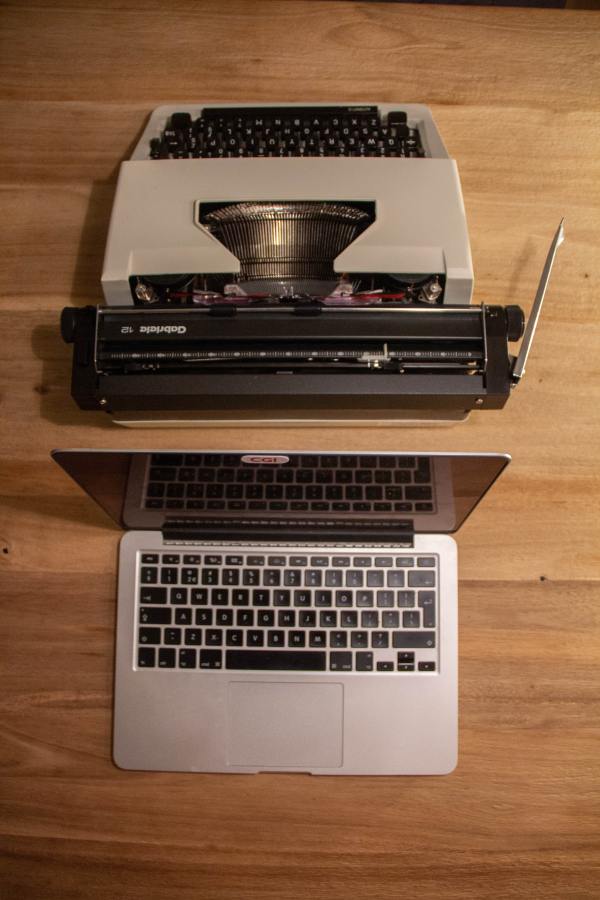
Photo by Tom Podmore on Unsplash

In the five or so years I spent as the white-paper editor for Ericsson, some writers would file their copy with two spaces after every period (or full stop if you prefer to call it that). During the noughties, I noticed a revival of the practice. One repeat offender confessed to ‘thinking it was cool and retro’. I think he was swayed by some romantic notion of novel writing on a rickety old typewriter with a view of crashing waves, instead of the reality — rows of white desks and brick-exposed industrial walls.

I learned to type on a typewriter in the early eighties during my final years of high school. Unlike kids who went to school in the US, learning to touch-type wasn’t part of the Irish curriculum. So, I taught myself (no comment). We were fortunate enough to have a typewriter at home and my big sister was a bit of a whizz, so I got some lessons from her before she got bored with me. That iconic clickety-clackety of the keys, the ding of the margin bell, and the smell of ink from the ribbon bar are all things I can get nostalgic about.

Manual typewriters use monospaced fonts — each character takes up the same width on the page — and it was best practice to type two spaces after a period. The idea was to help readers understand they had reached the start of a new sentence, to take a slightly longer breath. This practice was largely dropped when word processors and computer screens became capable of visualizing variable-width fonts. The gap seemed unnecessarily wide and no longer useful. One post I read said, ‘you could get a boat through it’.

Having to wade through someone’s copy and remove all the darn extra spaces (even if you can automate it) is a highly annoying waste of time for an editor. Don’t be swayed by romantic notions, mind the gap and please use a single space after a period.

Doyle’s dots — it’s or its?

Photo by Sear Greyson on Unsplash

In 1980 my parents realized their dream of shipping the family back to Dublin. Apart from a few distant summer vacations, I hadn’t spent so much time in my homeland up until that point. High school was noisy and chaotic, but I was doing okay, except in English class. Compared with my classmates, I found myself lacking in grammar skills and any understanding of the basic constructs of language. At the time, I attributed my shortcomings to the fact that we moved around a lot, and that because I had attended a couple of different schools, I had somehow missed those lessons. In hindsight, however, I believe my lack of knowledge might’ve been the result of some of the madcap experiments, such as the Initial Teaching Alphabet, which took place in the British education system during the early seventies.

Back then, my Dad wrote a lot. Most of the time, he’d be chalking up his findings on aircraft inspections, but sometimes he wrote accident reports, I think he investigated new technologies, and on occasion created suggestions for procedural improvements. To his aid, he had this massive manual called Written Communication. I can still see it now, a thick blue binder with pages and pages of explanations, writing tips, and do-it-yourself tests.

One day, I came home from school in tears — a rare occurrence for me. One of my ‘teachers’ had made a complete fool of me in front of the whole class, because I couldn’t identify the predicate clause of a sentence. Looking back, I doubt if anyone else in the class could either, but given my disposition at the time, I simply assumed that I was useless at English — a feeling that persisted all too long.

I’m guessing the tears spurred my Dad into action. He gave me the binder and told me to work my way through it. My heart sank. The thing was gigantic, I thought I was never going to get through it. But I did. However, like most useful skills, I didn’t become proficient until many years and many hours of practice later.

Today, I can recall most rules. But there are a few, which refuse to sit in my brain — I have to think twice, every time. But for this one, I have a tip that my Dad gave me back in the day, when even Written Communication — as good as it was ­— couldn’t help.

What he explained to me was the purpose of apostrophes. If we ignore how they are used (or not) to denote possession — John’s bicycle, the woman’s car, its wheel — and instead focus on how the apostrophe is used in contractions to show something is missing — don’t, can’t, I’d, would’ve — you’ll never make the mistake of writing its when you mean it’s or it’s when you mean its.

Doyle’s dots — It’s okay to start a sentence with ‘And’

Photo by Max Anderson on Unsplash

You wouldn’t believe the number of times people tell me I shouldn’t start sentences with ‘and’. And you can add ‘but’, ‘however’, ‘for’, and ‘while’ to the list of seemingly offensive words that shouldn’t be used as openers. I am not sure where this particular style guideline comes from, but my research seems to suggest that the construct is frowned upon because of its inelegance.

Now I grew up in the seventies. And at the beginning of every school week, we’d spend a couple of hours writing about our weekends. Woe betide any child who began a sentence with ‘and’, for they would endure the wrath of teacher’s red pen and the embarrassment of public humiliation. Personally, I believe it was this practice of news writing that is to blame for the ‘and’ rule. I believe it was post-war schoolteachers who made up this rule to protect themselves from the utter tediousness of childhood prose — endless strings of sentences that start with “and then I went to…”.

During the half-century that’s passed since the flower power era, our lives have changed dramatically and so has our language. I wonder what my primary school teacher would have made of words like flexitarian, emoji, upcycling, or — one of my personal favorites – booyah.


Avoiding repetition and creating rhythm are two of your best friends when it comes to writing — because they prevent your text from becoming monotonous (and your reader from wanting to stick pins in their eyes). A balance of long and short sentences will help to create rhythm. Awareness of the words you tend to repeat will help your text from the doldrums. My particular minefield is the word ‘enable’. I don’t think I’ve ever written a piece without it. In fairness, I work with enabling technologies, so it fits. But I balk every time I see it.

And it’s the same with starting sentences (like this one) with ‘the dreaded and’. Used sparingly, this construct can be great for creating rhythm. But if you start every sentence with the same word — no matter what that word might be — your text will be dull.


Here’s an example from E.M. Forster’s A passage to India, by my favorite language guru Benjamin Dreyer:

In the hospital he should be safe, for Major Callendar would protect him, but the Major had not come, and now things were worse than ever.

In the hospital he should be safe, for Major Callendar would protect him. But the Major had not come, and now things were worse than ever.

I think it’s clear that the second version is preferable because the rhythm makes the reader focus on the sad bit about the Major not pitching up — and it’s the one that Forster chose.

Tip

Go ahead, break your text free from the shackles of post-war idiocy, but do it deliberately and conscientiously to avoid copy that is boring and monotonous.

Becoming a Swedish citizen

Photo by Drahomír Posteby-Mach on Unsplash

My journey began sometime around March 2013. I was having lunch at one of my favorite haunts on Sankt Eriksgatan with a good colleague of mine. Joe (not his real name) is from Australia, and at that time, we were both working at a content agency. We share a love of technology and the written word but are deeply divided on the topic of cricket.

Joe and I were sitting at one of those bar-type long benches in the window of the restaurant. Outside, the sun was strong and low, throwing a spotlight on the grit and grime that the winter leaves behind on the streets of Stockholm. The passing cars sent plumes of dirt into the air, and I despaired at thought of all those carcinogenic dust particles.


Joe is incredulous. I’ve completely missed the latest social-media meme — the Harlem Shake — and he simply cannot believe it. I fell into fits of laughter when he showed me the Norwegian Army performing this — now-iconic — dance. Joe’s a bit of a joker, so at first, I thought it was some kind of prank. To this day, if I ever want a laugh, I just take a look at that clip — the dude in the sleeping bag and the guy out to the far left with his snow racer, tube socks, and shower shoes completely crack me up.

It kinda reminded me of the moment I first saw The Hampster Dance. I’m not sure if the Zoomers fully appreciate how ground-breaking this stuff was, my son (15) certainly doesn’t, neither does he get why I find it so funny.

But what do internet memes have to do with becoming a Swedish citizen? At lunch that day, Joe talked about one of the reasons he became a Swedish citizen. He wanted to be able to vote, and specifically to be able to vote against ultra-right-wing fascism that was on the rise in Sweden at the time.

Back then, I didn’t feel any need to become Swedish. As an Irish citizen, I felt I had as much freedom and I didn’t need any special permits to work in Sweden. I felt somehow distanced from the idea. But, over the years, the seed Joe sowed in my brain started to grow.

The rise of right-wing politics

In 2010, about two and half years before the lunch with Joe, the Sweden Democrats (Sverigedemokraterna) (SD) — the fascists Joe was on about — won their first seats in government, earning 5.7% of the votes and 20 of the 349 mandates.

In Sweden, you not only have to win your seat, but you also have to win at least 4% of the entire vote to be granted entrance to parliament. When I first moved here, I thought this idea was odd, almost undemocratic. I’ve now lived here for more than two decades, and like most of the stuff I found weird in the beginning, I have now gotten used to. Today, the idea of a 4% minimum seems smart. It prevents local celebrities from getting voted in and holding national governments to ransom. The likes of the Healy-Rae’s in Co. Kerry, for example, and their decades of conflict-of-interest, which I feel is an embarrassment to Irish politics.


In the 2014 election, SD won 49 seats. And in September 2018, they increased to 62, becoming the third-largest party in the Swedish government.  


In early 2018, while I was researching content for this article, repealing the 8th has nothing to do with abortion, it dawned on me that my emigration from Ireland had basically left me without a voice.

Irish citizens, who’ve lived abroad for more than 18 months cannot vote in local or national elections. But, as I found out, neither can they vote in a referendum.

The rules vary across the EU. French citizens, for example, retain their full voting rights when living abroad. Swedes living in another EU country retain their voting rights for national elections but have to renew their electoral roll registration every 10 years.

And so, in April of 2018, I applied for Swedish citizenship.

I’ve heard horror stories of people waiting years and I’ve heard lighthearted tales of people waiting a few days or weeks for the process to complete. At the time, one of my colleagues — a beautiful Russian lady — had just applied. She got her citizenship in just six weeks. Emboldened by her success, I filled out the forms, sent in my passport, and began to wait.

At the time, the number of cases awaiting decision was about the same as the number of decisions that had been made within the previous 12 months. I figured worst-case scenario was about 18 months tops. Within a couple of weeks, my passport came back, and I decided the best thing to do was to forget about it.

In August 2020, after more than two years in line, I figured I’d waited long enough.

But before going into battle with the Swedish Migration Agency, I thought it might be a good idea to arm myself with some facts, so I asked around for information. I wanted people in a similar situation to me — an EU citizen who had applied for Swedish citizenship within the previous three years — to tell me how long they’d been waiting.

I was surprised at being able to group people into roughly three categories:

The Brits

It seemed anyone with a British passport was getting prioritized. Given the timing, I can only assume this was due to Brexit. A former colleague of mine applied during the summer of 2020. It took six weeks for his application to complete — he told me it could have been faster, but his handler had been on vacation for a month. And of all the British citizens who responded to me, their stories were fairly similar. Most people waited somewhere between a couple of weeks and a couple of months — with the max at around six months.

People with kids

Then there were people who had kids attached to their applications (not literally). That group seemed to wait about one to two years.

Don’t get me wrong, I think it’s good that the system isn’t a blind first-in-first-out process, because some people need protection.

The odd ones

And then there’s my group — the people who on paper don’t seem to need to become Swedish — apart from the not so obvious reason of keeping fascists out of government. The responses I received from people in this group ranged between two years and 30 months, with one girl waiting almost three years.

Force a decision after six months

In August of last year, one of my American friends, who has also been through the process, told me about a service offered by the Swedish Migration Agency to force a decision — a service they provide if you’ve been waiting more than six months. So, I called them up. And after holding for about an hour, I finally got to speak to a handler. He explained the process and then he absolutely floored me. He said that if I applied to force a decision, I would be denied. I was absolutely flummoxed. Why provide a service that’s going to result in a blank denial? Why waste time that could be spent handling applications? And sure enough, six weeks after I put in my request, I received a letter saying that my request had been denied because — and I quote — they didn’t have time to process it.

Seriously, WTF!!! You’ve been sitting on my application for two and a half years.

I was given three weeks to appeal, but at that point, I had honestly lost all desire to become Swedish, and for a fleeting moment, I gave way to the idea that if I’d ever be given the chance, I might actually vote for those right-wing fascists after all.

Shortly before Christmas 2020, I received a new letter from the Swedish Migration Agency asking me for additional information — they wanted to know who I had been working for, my tax returns, and salary for the previous 5 years (information they could quite easily obtain from the Tax Office). In the initial shock, I thought they were looking for grounds to deport me — what I didn’t fully understand was that my original application for citizenship was still in the queue. The fact that my request to force a decision had been denied was irrelevant.

Today, two years and ten months later, I finally became a Swedish citizen. It feels odd. I will, however, be looking forward to voting in the 2022 election. I can’t say who I will vote for, but I promise you, it won’t be any fascists. Thank you Joe, and to all of you who responded to my questions over the years. 

Them, he, or she — gender neutrality, pronouns, and rabbit holes

Image Steve Johnson Unsplash

​​​​​​​If you know me, you’ll know that I have a habit of diving deep down the rabbit hole to solve an issue related to writing or grammar, especially when the rules seem to defy common sense. As a kid, Alice in Wonderland was my favorite story and the bizarreness of the world Lewis Carroll created for his heroine is a fitting setting for the nonsense of possessive pronouns.

The French are lucky for many reasons, but when it comes to singular possessive pronouns, they are fortunate because they use the same words irrespective of whether the subject is a he or a she — his and her are the same. His eyes (ses yeux) and her eyes (ses yeux) — the gender of the object dictates the form of the possessive pronoun not the gender of the subject. English, on the other hand, has no such gender-neutral possessive pronouns for the singular case.

In 2015, the Swedish Academy (Svenska Akademien) — who is responsible for the advancement of the Swedish language — added the genderless pronoun hen to the list of accepted Swedish words. Today, Swedish has three subject pronouns han (he), hon (she), and hen, and three possessive pronouns hans (his), hennes (her), and hens. Apart from addressing sensitivities related to gender neutrality and people who do not wish to be identified as he or she, such neutral pronouns tend to make writing easier. I should add though, that the addition of hen led to much debate, rolling of eyes, and general jadedness toward anything that could be labeled as politically correct. By now though, some six years later, I think the initial skepticism is beginning to die down and acceptance of hen is growing.

Working at Tobii, I often find myself wanting to express these kinds of ideas:

The user controls the interface with his eyes.

The user controls the interface with his/her eyes.

The user controls the interface with her eyes.

The default position in English writing was to use the male possessive pronoun in such cases. As gender-equality awareness grew, we switched to the awkward he/she construction, which too became jaded. And some writers will use she in all cases — often as a question of style or quirkiness rather than a political statement.

The problem gets quite absurd when using indefinite pronouns such as anyone, someone, or everyone. And in speech, we don’t think about it, because we incorrectly use the plural possessive pronoun.

Think about a classroom situation, where the teacher wants each kid to raise a hand. The teacher might say:

Everyone raise their hand!

This sounds correct because most native English speakers will say it that way. But everyone is singular, so ‘their’ is grammatically incorrect.  

The teacher could instead say ‘Everyone raise his hand’, but then we’re back to the gender issue, and because nobody ever says this, you might be left wondering whose hand is ‘his hand’, and why does he (whoever he is) need everyone else’s help to raise it. And down the rabbit hole we go!

You can often get around the problem by rewriting the sentence or using a plural. So instead of everyone raise their hand, you could be more specific by saying something like: could all the kids in the class raise their hand! Kids plural, so ‘their’ is grammatically correct.

Here’s a good example of rewriting from the AP Stylebook.

Instead of:

The foundation gave grants to anyone who lost their job during the pandemic.

Write:

The foundation gave grants to anyone who lost a job during the pandemic.

Over the past couple of years, most style guides have adapted their rules on the use of ‘their’ as an acceptable use of the singular possessive pronoun. The most commonly used style guides are more or less in agreement, however, that it’s better to rewrite if you can because they kind of want to reserve ‘they’ and ‘their’ pronouns for people who identify as nonbinary.

But I would say that it’s okay to use ‘they’ and ‘their’ in cases where you are referring to people in the singular. So, in the first example above, I would opt for:

The user controls the interface with their eyes.

Or you could rephrase:

Users control the interface by moving their eyes.

A word of warning

Be careful, however, when you have a plural subject and a singular object. I would advise you to re-read your sentence a couple of times to check that your sentence makes sense (unless of course you are writing literary nonsense).

Take a look at this sentence:

Users control the interface by moving their eye.

It might just be me, but at first glance, I think this sentence is okay. But then ‘users’ (plural) do not have a collective eye (singular), even if I think most people will get what the writer means.

Interesting articles on this subject:

They — Merriam-Webster’s word of the year 2019

What is the singular They, and why should I use it? (Grammarly)

To hyphen or not to hyphen — the compound’s dilemma of clarity over clutter

Photo by Samanta Santy on Unsplash

Compounds, words composed of two or more words, are sometimes spelled with a hyphen, as in mass-produced and go-between. Sometimes they take a space and sometimes they don’t. And if that wasn’t complicated enough, sometimes, their spellings change over time. The only way to get it right is to look it up in the dictionary. But when that yields nothing, what do you do?

Recently faced with the problem of how to spell a two-word compound, I never imagined how deep down the rabbit hole I would dive to find an answer. I have traveled through Wonderland and find myself on the other side with an entirely different point of view to the one I started out with.

But here I am, and this post describes my journey through the odds-and-ends of how compounds morph and change, and the pros and cons of how you might spell them.

Open, closed, or hyphenated?

The hyphen has several uses. Just like many other punctuation marks, its primary purpose is to prevent confusion. It’s designed to help you, the reader, interpret a piece of text just as I, the writer, intended. It’s my job to make sure that you don’t have to work too hard.

Open, commonplace compounds such as living room and real estate take a space. Go-between uses a hyphen, and closed compounds, such as football and crosswalk, are bound together.

Over time, some compounds evolve. Shifting from open, through hyphenated, to a closed compound as they become familiar. Such as cab driver, cab-driver, and today we write cabdriver (en-us), but for en-gb, we still use cab driver. Well taxi driver might be more accurate.  I grew up with en-gb in school, but today I primarily write in US English – the lack of consensus is my favorite alibi for my perceived or actual confusion.

Evolution of compounds and effect on tone-of-voice

Teenager was once written as two separate words. Sometime during the 1940s, it took on a hyphen, and its first appearance as a closed compound was in the late 1960s. Today, The New Yorker still hyphenates teen-ager. The New York Times, however, moved over to teenager just before the turn of the 21st century. Merriam-Webster lists teenager without a hyphen, but as a writer, I am free to apply my own rules. The problem comes when you’re trying to create rules for a bunch of people, to make it easy for everyone to be consistent. Magazines and newspapers employ subeditors to ensure that copy, no matter who writes it, is consistent. Organizations rely on people adhering to their style guides — with moderate success.

The day The New Yorker changes its style guide to reflect modern usage will undoubtedly be met with uproar from loyal subscribers like myself. I am likely to go into denial, anger, and eventually accept the change – I might die first. For me, the humble hyphen in teen-ager sets a tone that reflects a desire to belong to a bygone era. A feeling that will be lost when the hyphen is no longer.

The evolution of technology and its impact on spelling

Digital-first publishing and widespread access to content by international audiences have heightened the need for simplicity in written communication. The result has been a shift toward minimal punctuation. Familiarity and minimalism have led to on-line becoming online, and email is now preferred over e-mail – even if Merriam Webster still (April 2020) lists e-mail as its first preference.

Some open compounds, such as ice cream, living room, dinner table, and coffee mug, however, haven’t evolved over time. These open compounds seem to describe commonplace items. Whereas closed compounds, such as eggplant, earmark, and honeymoon, are less common and also reflect changes in use over time. Earmark, for example, stems from the way farmers would make a nick in the ear of an animal to define ownership.

There’s a funny moment in Four Weddings and a Funeral where Charles (Hugh Grant) offers Carrie (Andie McDowell) a suggestion for the etymology of the word honeymoon:

“I don’t know. I suppose it’s ‘honey’ cos it’s sweet as honey
and ‘moon’ because it was the first time a husband got to see his wife’s bottom.”

So, it seems logical to adopt an open compound for commonplace broad-reaching ideas such as social distancing, a hyphen if you want to emphasize a connection that may not be obvious, such as head-banging. And a closed compound if the concept is familiar.

Use a hyphen when a compound describes something

Consider the sentence:
The butler’s head movement patterns.

Without a helping hyphen, you might stumble and think the butler’s head is the subject of the sentence. And so, some copywriters would apply the rule of hyphenating compounds when they are used as adjectives. To give: the butler’s head-movement patterns. Some subeditors (you know who you are) might argue that the hyphen isn’t needed because there is no room for confusion.

Hyphens in Google search

Just as Google search is case insensitive, it is also hyphen insensitive, so searches for head movement and head-movement should reveal the same results. However, according to Google, such terms are sometimes treated as reciprocal synonyms, sometimes not. See this Twitter post. Unfortunately, search results are inconsistent, and there are more reasons for this than the presence or absence of the hyphen.

Google is continually evolving its algorithms to provide more individual – more relevant – results. Browser activity (what you’ve clicked on in the past) and location have a significant impact on search results.

Sound copywriting should never be sacrificed to cater to Google’s current search methodologies because they can and will change.

Most web-publishing tools provide features to overcome this problem so that Google rates your content, irrespective of whether people search for head movement or head-movement.

A breathing space

There is, however, a compelling argument for adopting an open compound when a hyphen might have been the obvious choice, at least for those of us who went to school in the 1970s. Because it creates breathing space. It avoids the clutter of hyphens when they are not strictly needed. It can make a statement.

Strategies for consistency

Imagine I’ve created an innovative technology for monitoring head movements. I can choose to spell my tech as an open compound, with a hyphen or closed. I’ve decided not to go with the closed version, headmovement, because it’s hard to read.

I now have three choices:

Strategy no.1 — hyphens everywhere

Adopt head-movement for the noun and head-movement when used as an adjective.

ProsCons
  • Easy to remember and apply
  • Reduces the chance for reader confusion
  • Is consistent
  • Ensures the solidity of head-movement as a single concept
  • Creates unnecessary clutter
  • May stick out negatively

Strategy no.2 — the copywriter’s choice

Adopt head movement for the noun and head-movement when used as an adjective.

ProsCons
  • Pleasing from a style perspective – follows the rules
  • Avoids some clutter
  • Paragraphs that include both head movement and head-movement may cause reader confusion. But simply avoiding such situations solves this problem.
  • Not easy to apply consistently across an organization
  • Creates some unnecessary clutter

Strategy no.3 — bunk the hyphen

Adopt head movement for the noun and the adjective.

ProsCons
  • It makes a statement
  • Easy to implement
  • Clutter-free
  • It may lead to reader confusion, but with good style, such situations can be avoided
  • May set the hair of most editors/copywriters/wordsmiths on end

The other side of Wonderland

Before I wrote this post, I was a firm advocate of the copywriter’s choice. Sometimes, I have even adopted the hyphens everywhere approach because I believed it helped to avoid confusion. Having taken a trip down the rabbit hole and woken up on the other side of Wonderland, I’ve decided to step out of my comfort zone and bunk the hyphen when the compound is the protagonist of the story. Why? Because, writing this post has made me realize that the rules apply to compounds that appear once or twice in a text. But when a core subject is frequently repeated, readers will grasp the idea soon enough. Irrespective of whether the concept is new or familiar, after a few repetitions, people will read the open compound as intended, as a single concept.

Doyle’s dots — is there a better word than better?

Photo by Blake Guidry on Unsplash

I’ve recently read, or should I say devoured Dreyer’s English An Utterly Correct Guide to Clarity and Style. I never imagined I’d find a replacement for Strunk & White. Still, it seems that a century after The Elements of Style was first published (a book that changed my writing and my career), I now have a new bible. A new guide that’s not just an excellent source for creating good copy, it’s also a great read that has me seesawing between laughter and cringing at the memory of my past mistakes. 

One of my favorite chapters in Dreyer’s English is number 9, Peeves and Crotchets, which includes common pitfalls of writing and the many cases of abuse of the English language — all delivered with fantastic wit. Unfortunately, my pet peeve, related to the word better, is missing.

It’s a simple word and used in context; there’s nothing better. For example:

  • The fuel consumption in our new car is better than our old one.
  • The food is better at my local store than at the hypermarket.
  • My son has a better education than I do.

So far, so good. There is little room for misinterpretation. The reader is free to make up their mind about what has improved, which in some cases is fine.

Looking at the image I’ve chosen for this post, some people will finish the sentence on the carton, so that it reads: boxed water is better… better than in a plastic bottle. Some might think boxed-water is better because the stuff that comes out of their tap tastes like a visit to the dentist. And for the 600 million people who don’t have access to an improved water source, they might be wondering why you’d box water at all.

Continuing with this train of thought, if you ask yourself the question, why is my son’s education is better than mine, you might come up with several responses:

  • The education system today is more efficient than it was in the 1970s. So at 15, my son has learned more than I had at the same age — a subjective opinion about the education system in any given country/state/region.
  • Teaching methods have evolved. Children today are taught to think and make their own minds up about how they want to solve problems — which is a subjective opinion about teachers based on the assumption that teaching methodologies have evolved.
  • I completed high school, whereas he is currently studying for his Ph.D. — contextual information that’s missing from the original sentence.
  • He grew up in a country where education is free and available to everyone, whereas I didn’t — again contextual information that’s missing from the original sentence.

The truth of the matter is. It’s probably a mix of the first two, but that’s not the point of this story.

My problem comes when the meaning isn’t clear and there is no context to provide it. And, it seems to me that the problem occurs more often in short headlines, sub-headers, and taglines.

Imagine a highway billboard advertising a car dealership. It states better cars, better deals, better driving.

You might think that’s fine, and under different circumstances, I might agree with you. But if you are in the market for a new car, would these words entice you enough to exit the highway and take a look?

Unfortunately, when you work with words as much as I do. They sometimes morph into weirdness. When I see headlines like this, it sets off a multitude of questions in my head because I don’t know what we are comparing with; better cars than what? Better than the one I am driving, or better than the one in front of me? And why is it better? Because it consumes less gas, or because it’s a 4WD and that will ensure that I can get my kids to school after a snowstorm, or is it because it’s electric and that’s clearly a better option? The point is that better is highly subjective. People interpret the word better, depending on their personal needs and current circumstances.

So, what to do?

How does the copywriter solve this issue? I don’t have a definitive answer, but I feel that similar words such as improved, larger, bigger, greater, and so on, they all suffer from the same disease.

In standalone copy, I tend to opt for words like enriched and enhanced, because these words contain an understanding of improvement to the same object. In other words, the current version of <whatever it is you are trying to sell> is better than the previous version of it. The addition of the prefix en-, meaning in or within, somehow helps to convey the concept of self-improvement, which hopefully then turns the statement into an objective one.

What words do you use?

I’d love to year your ideas on words that are better than better. So drop me a line in the comments below.

Bullies on the beach

Today was my final opportunity to do nothing before I start a new job next week. I’m by myself in La Mata, Spain, for a couple of days of relaxation with little to do except enjoy the daylight — a rarity in wet Stockholm Novembers — and the freedom of not having to be anywhere at any particular time. Simple and fabulous.

But instead of doing nothing, this morning I decided to do something touristy. Something I probably wouldn’t do when we come down here during the summer. I chose to go on the local tour of the salt flats of Torrevieja, which is carried out in true tourist style, on one of those excruciating choo-choo trains. As we age, we learn to appreciate the things, which in our youth, we regarded as sad, boring, or naff. The tourist choo-choo (along with cheese in a tube) remains on my list of highly-uncool-things this planet has to offer. I don’t think I’ll ever enjoy them.

That said, many years ago, Charlie was about five, me and the rest of my family (I won’t name them for fear of lawsuits), hopped on the local choo-choo and paid a fortune to get a ride home. Much to Charlie’s amusement and my nieces’ chagrin, we, the adults (:-)), sang along to the tunes piped over the loudspeaker, despite the fact that none of us could speak a word of Spanish, let alone the words of the songs. We just made it up as we went, roaring in the appropriate places, and falling apart with laughter. Charlie loved it.

Hilarity was perhaps not the word I would use to describe today’s choice of tourism, but it was interesting and offbeat – characteristics that appeal to me, so the trip was worth the effort of breaking the rule of not having to be anywhere at a given time.

The trip around the salt flats takes about an hour and I was in good spirits when we returned to Torrevieja. I decided that a cup of coffee on the strand, or maybe even lunch, would be a perfect way to complete the morning. So, I ambled along the seafront until I found one of those outdoor cafes with ocean-facing sofas. It doesn’t get any better than this: I don’t have to be anywhere, I don’t have to cater for anyone else’s tastes, I have only myself to please. So, I plonked myself down on a vacant sofa and started to people gaze as I asked the waiter to bring me a menu.

I’m in karma heaven. I’ve satisfied my cultural curiosity. I’ve learnt something, and I have a new experience to share with my family and friends.

Sitting in the sofa in the row in front of me are three people. Jordies by the sound of it. I didn’t pay much attention to them at first, until it happened. A waft of cheap tobacco smoke caught me off guard and I coughed. I say coughed because there’s no English word for the sound I involuntarily emit when I ingest someone else’s cigarette smoke. It’s somewhere in-between a cough, a belch, and a cat with fur balls. Not attractive, but in my defense, I don’t appear to have any control over my reaction. And today, the geezer sitting in front of me was smoking some cheap nasty shit. I didn’t think I was that loud.

My reaction removes me from my reveries and I come crashing back into the scene around me. I start to take notice of the people sitting in the sofa in front of me. There’s three of them, they have their backs to me. They are all smoking. The old man with the smelly tobacco, a younger woman, probably in her late thirties, peroxide hair and an abundance of puppy fat, and another man who I’m guessing is probably the same age as her, but he looks about 70. It’s windy and I find myself wondering if she’s cold in her summer top and shorts.

It’s an onshore wind, which unfortunately for me, carries their cigarette smoke right in my direction. I start scouting for somewhere else to sit, but all the sofas are taken, at least for the moment.

To avoid getting smoke in her face, the peroxide lady turns around, toward me, to smoke her cigarette. She is now glaring right at me, with all the glory of her nicotine adventure belching right into my face. I politely ask her to turn back around, which she does without hesitation and that, I hoped, would be the end of it.

The waiter comes with the menu and I check out my options. The smell and tension have made me lose my appetite. I’m thinking about ordering a coffee, and perhaps a pain-au-chocolat to keep me going. I narrowly missed the opportunity to move seats and I am contemplating going home but am reluctant because this is such a good spot and I feel good. The midday sun is warm and the view of the Mediterranean incomparable.

And then it happens again. The waft of cheap nasty tobacco catches me off guard, and I make that noise again. Fuck, what the fuck is wrong with me!

Ms. Peroxide turns to face me again, glaring down at me:

Her (Jordie drawl): Ya, can sit sum-ware else y’ know, it’s a free country, laik.

Me (surprised that another human being would speak to me because I coughed): Yes, I know, it’s just that the smoke is disgusting.

Her (now aggravated): well things you do might disgust me, y’know

Bloke on the right (massive sarcasm): It’s the wind ya know, it’s the direction of the wind, I’d change it if I could.

I think to myself. Three bullies. And I don’t need an explanation of the current meteorological conditions to know that I’m not going to get out of this situation with my dignity intact, unless I bugger off.

I get up to leave.

Bloke on right (more sarcasm): If ya want me t’change direction of wind, I would.

And he says this twice. It appears I haven’t heard him the first time despite the fact I am standing less than a meter away.

Me: I don’t appreciate the sarcasm, you’re being rude and inconsiderate, just like your prime minister!

As I walk away, I hear the blonde saying in a slightly meeker tone, “just like your prime minister!”


I want to be even ruder. I know they detest Boris Johnson up North, so what I’ve already said is probably enough. I want to turn around and tell them that Europe will be a healthier place without pommie gits like them in it. Get Brexit done FFS! I want them and their disgusting habit to move. I want to tell them I don’t want to die from secondary smoke inhalation. I want to yell at them, “where I come from, we don’t have a Prime Minister”. But all that would be wasted. I feel hot tears at the back of my eyes, the reminder of childhood bullies. I am sad and distraught that my karma could be blown apart in the space of five minutes by three strangers.

I keep my head high, walk to my car, and drive home.


While driving, I remind myself of that mantra, the one that advises us to not allow other people to ruin our day, and I think bugger it. My moment was ruined. Cheap, nasty-smelling smoke ruined my moment – it’s just a fact. The moment was gone. I decided that the mantra’s message is perhaps not to dwell, to avoid becoming the victim, and somehow rise above the comfort that is offered by laying down in the gutter – easier said than done my friends!

Once home, I’m now starving. I have two choices: eat the dodgy packet soup that’s been in the cupboard since who-knows-when or walk 20 minutes to one of the locals. I chose the better option and took a stroll down the beach to one of the seafront restaurants. It was quiet, I ate an absolutely fabulous lunch while I watched a family brave the cold of the November sea, the surfers battle the waves, all while people around me smoked like troupers. I was upwind.

In retrospect, I’d say I had a better lunch and a better afternoon owing to the bullies on the beach.

Summer reading — book number one, Say nothing

Photo by Lukas Eggers on Unsplash

This summer, my love of books, of getting lost in other people’s adventures and lives for days on end was re-kindled. Now a pre-teen, my son no longer demands hours of on-tap attention, and so I found myself with time on my hands to read more than the usual New Yorker article rapidly devoured with coffee. I dove into six books in as many weeks, all of which have touched me in one way or another. It’s been sort of like rediscovering thoughts and feelings where dust mites had taken hold. Therapy of a kind.

Book number one — Say nothing: a true story of murder and memory in Northern Ireland (Random House), by Patrick Radden Keefe (who incidentally also writes for my favorite magazine, The New Yorker).

Say nothing is a tale of the Troubles in Northern Ireland centered around a few hand-picked characters, including the Price Sisters, Gerry Adams, and Brendan Hughes — people who played significant roles in the shaping of events.

Keefe’s storytelling of the fighting, fear, and sensitivities that reigned over the streets of Belfast some forty-odd years ago is gripping. Unlike other books I’ve read about the Troubles, Keefe focuses on his characters, their lives, and emotions. As he recounts their intertwining stories, he makes them feel like your neighbors, people you know and care for. The pages reek with the smell of gunfire and misery. The people in the book are real, as are their testimonies, and the incursions they were involved in. Intertwined with the documentary of his main characters, Keefe unravels a murder-mystery, and provides a discourse on the effects of PSTD, of aging and the human tendency to recall the past in varying versions. The book is a documentary of violence and war, a true crime novel, and a dissertation of human regret. It is the story of the murder of a widowed-mother of ten children and the suffering of generations.

With the benefit of hindsight, Keefe is able to illustrate how people change, how memories alter as we grow older, and how idealism — so bravely fought for by young men and women–takes on a new reality with age. Regrets and remorse set in. I wonder about the radicalization of so many young men and women today, how they will feel decades from now.

Midway through the book, we are transported to London, to the scene of the London car-bombing of 1973. I was seven at the time, living in the heart of the English countryside together with my parents and two older sisters. We lived in a small, tight community. Gossip was rife. Be damned if you stepped out of line — everyone knew your business. Everyone knew who you were. Somewhat like the characters in Keefe’s story, without the violence.

My playground peers regularly asked me
if I had a bomb in my pocket.

Sometimes, in the aftermath of an IRA bombing on mainland Britain, I was completely ostracized, sent to Coventry, as it was called. My friends and classmates would refuse to speak to me or acknowledge my existence. They blamed me for the bombings. I was held accountable for the actions of the IRA. Thankfully, small kids are not capable of maintaining this kind of treatment for more than a couple of hours, but my sisters and I were urged to say nothing — a strong undercurrent and sentiment of the times, which Keefe captures so eloquently.

As I grew up, the playground behavior continued. In the 1990s, I was living in Paris, when another London bombing sparked a similar reaction in a colleague of mine (a woman from a country also torn apart by racial and social discrimination). As an adult, I expected more. A deeper understanding, less immediate judgment. Yet it remained that as an Irishwoman and presumably Roman Catholic these two factors were sufficient to convict me of pro-IRA sentiment. I continued to remain accountable for the actions of the IRA in the eyes of my peers.

Having read Say nothing, I am left wondering about the impressionable teenager version of me who possessed a desperate desire to belong. Had I been born of Belfast parents, would I too have looked to the Price sisters as idols and in some way got caught up in the armed struggle? Would I too have been radicalized? An act that with age, motherhood, and responsibility I know I would have regretted, or perhaps not survived to experience regret.

Thank you, Patrick Radden Keefe, for your storytelling, for writing a book that reminds us of the sadness and human suffering brought on by a war whose pain lingers on. Its arrival is timely because my country hasn’t recovered. Peace is delicate and the prospect of a re-instated border in Ireland is already causing unrest. I do not wish for my son–or any child–to live or witness the hell you describe. Say nothing, okay. But do something, at least read this book.

Repealing the 8th has nothing to do with abortion!

Photo by Mohammed Hijas on Unsplash

Repealing Ireland’s Eighth amendment is about removing decades of oppression Irish women and children have endured at the hands of the Catholic Church and the Irish State. Without retribution nor a conscience, these two institutions have systematically kept women at a disadvantage and sold and abused our children. Repealing the Eighth is a small, but vital, step toward unravelling the damage caused by years of lies, deceit, and denial.

In the early summer of 1982, just as I was about to turn 15, my classmates and I were sitting our Inter-Cert exams. Education systems vary across the globe, but back then, this set of state examinations were the first formal tests high-school kids in Ireland sat. Typically characterized by weeks of cramming while the sun is shining, tears, fears, late nights, the hopes for certain essay questions, mathematical proofs, and the dreams of being able to pull off a good still-life against the clock.

Of the two weeks or so the exams continue, one day sticks out, with a memory that nags at my conscience — the day of the music exam. I was my usual nervy self, particularly concerned about my ability to recognize a given piece of music when it was played. In those days, we didn’t have the technology to listen to the works of Bach on repeat — scratched LPs played on a turntable were our only exposure to the music we were supposed to know by heart.

Sitting in the back of the music room were a handful of girls around my age who weren’t from our school. They were sitting the exams just like me, seemingly nervous, just like I was.

The only visible difference between me and these other teenagers, was that each one of them was somewhere between five and nine months pregnant. The vision of one girl in particular still haunts me. She looked like she was wearing a nightdress, heavily pregnant and seemed to be in pain. I wondered how she could sit, let alone focus on the obscure tones of Claude Debussy.

Us local school kids had been instructed not to look, not to engage, not to talk. I refuse to repeat the words that were bandied around, disgusting words used to describe these young women. Heinous clichés uttered by the very nuns who were supposed to be taking care of these of young vulnerable girls, many abandoned by their families. The fear in my soul that day ensured that I didn’t talk to any of them, I too, like everyone else in Ireland, turned my back.

To all of you young girls who experienced this torture, in this case at the hands of the nuns of the Good (seriously) Shepherd Convent in Dunboyne, I hang my head in shame. I am sorry for not showing you the shred of decency that remained locked inside of me.

Repealing the Eighth is about removing those chains of fear.

Fear served as the insurance policy for the nuns and the priests of Ireland and the barbaric institution they belong to. Fear was the mechanism ensuring people were kept in their places. It ensured that my newly-widowed grandmother paid her dues to the church. She worked three jobs to feed and clothe five children. Yet the church saw fit to take her money to ensure her husband’s name was mentioned during the service on Sunday — knowing she feared the scorn of her neighbors more than an empty dinner table.

We lived in an era of self-perpetuating damnation. Starting with the church ensuring that State opposition to contraceptives — not even condoms — remained firm. The sense of shame, preached from the altar, causing parents to abandon their own children into the ‘care’ of mother-and-baby-homes. That we could even call these centers of horror as such makes me weep. The enslavement of women, baby-making machines, who once married were no longer welcome into the workplace. The fear of excommunication for getting an education at my own Alma Mater, Trinity College Dublin. All providing the church with a constant flow of children to abuse and pregnant young women whose babies could be sold. And so it went on.

While international media was sobbing over the tragic case of Ann Lovett (15) who died shortly after giving birth in a field, my English teacher/preacher Sr. Anna (who incidentally worked at the Dunboyne institution), reminded us what of happens to young girls. No compassion for a young girl’s dilemma. Just pure damnation! Right on the back of the abortion referendum, which brought the Eighth into existence, you might wonder what we were thinking back then — I was unfortunately too young to vote at the time. But as is often the case with Irish politics, the facts were muddled with emotions, women were hailed as murderers and witches, and the poor innocent babies — yes, the poor innocent babies that the church would no longer be able to sell if people had a choice.

This referendum is not about abortion, it is not about the rights of the unborn child, it is not about what you believe in or what you don’t. It’s not even about providing women with the freedom to decide over their own bodies. This referendum is about removing the shackles of fear that the church and the Irish State have used to keep Ireland’s women and children enslaved.

Save the date, be sure to vote. Repeal the Eighth.

What it feels like for a girl — part two

Photo by Robert Metz on Unsplash

During the latter half of 2017, the metoo hashtag put sexual harassment and inequality in the workplace slap bang in the spotlight. In the three decades since I began working, it seemed that the female voice had finally gained a foothold, people started listening. Something had changed. Heads were rolling. Women were feeling free to wear their high heels without fear of retribution.

I learned something from all of the stories, some of which tore strips off my soul. I learned that no matter what we try to do as individuals, it was going to take a revolution to break apart the male domination, the old boys club, that pervades the world we live and work in.

In my early twenties, I was working in an R&D center as a developer. In those days, there wasn’t the shortage of women in technology that there is today — well at least not where I was working, I had plenty of female colleagues. The hierarchy remained predominantly male, but that didn’t scare me, I was smart, feisty, and rebellious. I was happy.

This is my #metoo story.

At the time, I believed I handled the situation without too much damage. But, once I started writing this story, nearly thirty years after the fact, it struck me just how much that one experience has shaped my life. How it knocked my confidence, and how it eventually pushed me out of technology.

I was working with a team of developers on a project that was researching automated air traffic control — theoretically a fun project with lots of opportunities for learning. Our team lead was an external consultant, a married man in his early thirties with two kids and zero understanding that a daily shower, if nothing else, is a common courtesy to your fellow colleagues. All was fine until one evening I received a phone call from him at home asking me to join a dinner. I thought it was a bit weird but accepted anyway.

Five minutes into the evening, he made it clear this wasn’t a casual bite to eat among workmates. I swore to myself, thinking shit, how could I be so bloody naïve. So, I made it equally damn clear that I was not interested. And that I hoped was that. No harm done. A man is, after all, allowed to ask a woman out on a date — right? And a woman is allowed to accept without fear.

Over the next six months, the man plagued me to go out with him. I invented boyfriends, squash matches, laundry nights, anything to avoid being alone in this man’s company. Nothing I said had an impact on his willpower to get me where he wanted. After a while, the situation started affecting my performance, my desire to come to work. My hair started falling out. At some point, I discovered that the day he first called me was the day he officially got divorced from his wife – that sent me retching all the way to the bathroom. The more I said no, the more determined he became.

And then he started making things difficult for me at work. He once said to me that I would be better respected if I could learn something about networking. He said I was slow and that I wasn’t creative. He constantly made me out to be an idiot in front of the team, saying my code was flawed. I was made to come in at weekends and holidays “to make up for my shortcomings”. On these occasions, it was often just me and him in the office.

I wanted to take on a new role, to develop the interface that would demo our project – partly to get away from him, partly to learn something new. He told my boss I wasn’t smart enough and gave the role to someone else.

The tipping point came when he hosted a team dinner party. I invented yet another excuse not to attend. And he kept postponing until even he realized he was beginning to look like a buffoon. I didn’t go.

I remember vividly the feeling on my way to work the following day. The sun was shining, I felt victorious, I’d shaken him off, I figured he could no longer go on badgering me — by this time, I had told some of my closest teammates what was going on.

My high spirits didn’t last long. The minute I arrived, he came flying into my office rabbiting on and on about what a great night I’d missed, and what a brilliant chef he was. All I could hear was white noise; the fear was back. He pushed me one last time, told me the food was so good that he would make it again — just for me, just for me. I can still hear those words ringing in my ears. My heart was racing, I felt trapped. Nowhere to go, no way out.

I went to my boss.

Let me put this into perspective. I was 25, working in France. It was the early nineties. My boss was a 60-year-old Frenchman who smoked in my office and dumped his ash on the floor. He was a tough ex-military man with little emotional understanding. He laughed, he brushed it off, told me I was a pretty young thing, and “What could I expect?” I spent the rest of the day in the ladies’ bathroom waiting for the bus to take me home.

Shortly after, I left for the US on an exchange program with another research institute. The man in question also left to start his own business. I thankfully never saw him again. But my love for technology started to die. Because of that one bad individual. I questioned my capabilities for the first time in my life.

Recently, I heard a man say that women are not as good at coding as men. To you, I say, you idiot, you lost my respect in that instant. And to the same man who said, “We don’t have any metoo problems here,” you are an idiot. To any woman who hears a man say these things, I say this: don’t let them beat you down, don’t let their gender bias make you feel inferior because you are not. I know that now.

Thank you #metoo for providing me with a voice. Hear me roar…

The laundry room

Photo by Kristopher Roller on Unsplash

I was having a conversation today with a fellow non-Swede colleague when he mentioned the dreaded word…. tvättstuga, which loosely translates to washing cabin. Long a socialist and environmentally forward thinking country, the tvättstuga is a staple of every basement in every Swedish apartment block. And like many things in Sweden, there are deep-rooted social rules governing how you behave in the tvättstuga. Rules that Swedes take for granted, because they are part of their DNA. Rules that are governed by respect for the the time and space of your comrades.

In the capital, the demand on the laundry room is high and governed in most buildings by a booking board — 31 days separated into time slots. Everyone who lives in the building has their own booking marker, which you move to the time and date you want to use the laundry room with a special key. As most rooms are only in operation between 08:00 and 22:00, getting an evening slot during the week or a weekend slot is as rare as winning the lottery.

If someone tells you they cannot make an event — even if it’s your wedding — because they’ve got laundry time, that’s a legit excuse. In fact, laundry time is the only thing people will not juggle on their busy schedules.

So, let’s get back to the word, tvättstuga, and talk about what it really means. There is so much emotion tied up in those 10 letters: rules, order, neighbors, solidarity and who didn’t remove their sodden dryer fluff from the communal towel?

In Sweden, you can cancel a meeting up to 5 minutes before it’s due to start, you can postpone lunch dates 20 times and no-one bats an eyelid, but dare to suggest that you might not bother going to the laundry room (because you have something more interesting to do like watching paint dry) you will quickly become a social outcast.

Entire lives revolve around laundry-room booking times and the millions of etiquette rules, that no Swede ever bothered to write down for us silly foreigners because… well you just wouldn’t think of stuffing a load on 10 minutes before your allotted time was due to run out now would you?

Because you would, like any normal person be mopping the floor at that point! And you would of course have already cleaned out the soap-powder dispenser thoroughly so that the next person wont bleach their black undies, and you have removed all the fluff from the dryer now, haven’t you?

Because if you don’t, you are in grave danger of being severely reprimanded by them…the laundry-room police! They will threaten you with all sorts of things if you don’t abide by the rules that you’ve never read. The ultimate being the removal of your booking key, so you can no longer use the laundry room and thereby become a social pariah as you can no longer blame your lack of spontaneity on a laundry-room booking, but on your lack of clean clothes!

Choosing technology — what it feels like for a girl

Photo by Maxime Bhm on Unsplash

How much influence do we have over our own destinies? How much does the world around us, and the people who surround us, our families, teachers, idols, and the media/YouTube. How much do they play a role in the choices we take? If I was to give advice to my younger self about career choices, I would tell myself to ignore my inhibitions, and not to allow my perceived lack of anything get in the way of participating in things I believed to be amazing. This is my story, how I came to choose technology, some of the people who opened doors, and those who wanted to close them. 

At the age of six, I remember sitting in school working on multiplication cards. Simple sums, based on our existing knowledge of times tables. A competition broke out between me and the kid sitting opposite me. I don’t know how it began, and I have no recollection of his name, but I have a strong memory of “I will not be beaten!” Most days, I’m not aware of possessing a competition devil, but it seems to kick in, when I need it. Traditionally, girls are not always encouraged to embrace their competitive edge. But, I was fortunate. Family games of cards were about winner takes all, and my liberal first teacher, Mrs. Wright, praised effort irrespective of gender.

Recently, my mentor from University paid me a visit. We spent a few hours walking and talking, catching up. We discussed Computer Science, and how he was extremely happy to have achieved a life-long goal: to include this subject in the high-school curriculum in Ireland. And even if I no longer code for a living, we talked about how the skills needed to write an algorithm — planning, understanding problems, logical thinking, testing, and refining — can be applied to many disciplines. Ireland has understood that technology is fundamental to achieving its long-term economic goals. A future that should include everyone — not just the alpha males.

NASA’s revelation of the Trappist-1 planetary system brought me back to my childhood fascination with space. My parents talked a lot about the moon landings, but the science lesson I remember the most took place at our kitchen table. My Dad sketched the entire solar system on a large piece of paper. I watched, fascinated by his ability to pull exciting facts about planets, orbits, and the effects of axis tilt on our seasons, all straight out of his head.

The NASA discovery also made me think about one of my art teachers, Mr. Jenkins. As a lanky teenager, I never believed I possessed any artistic skills, but under this man’s guidance I painted a sci-fi poster, complete with alien space ship, bright landing lights, Martians, and a sense of foreboding. His teaching skills made us kids work hard, but his greatest gift was his belief in us. He worked on our minds to make us believe that we could master the paintbrush.

In 1976, we moved to a new town, which meant a new school, and an uneasy feeling in the pit of my stomach. My Mom accompanied me on the first day, when I was interviewed by the headmaster. When asked what my favorite subject was, I replied that it was maths. I didn’t need to think about it, that’s just the way my world was. I remember this tall, gangling old man peering down at me through his half-moon spectacles. And then he uttered the following words “that’s highly unusual for a girl.” I was nine, living in a foreign country, and educated not to talk back to people in positions of authority. But a thought bubble immediately popped into my head. One that I have carried it with me since. It went something like this “what an exceedingly odd man you are.” I attributed his comment to his apparent age. Yet, I am saddened to hear people continue to utter such lunacy.

Four years later, we moved again. This time, it was back to my native Dublin, which in my head at least was a matriarchal society. Before she passed away, my paternal grandmother ran our family, mostly men, with kind, yet unquestionable leadership. I find myself yet again being interviewed by yet another male headmaster — this time in the presence of both of my parents. I was asked to pick two topics from a list of non-compulsory ones. I chose woodwork and music. To which the headmaster responded, “girls are not allowed to take woodwork or metalwork.” I was outraged — yet again. But this time, I didn’t keep my opinions to myself.

My geography teacher, almost as a casual comment to me after class one day told me that I was university potential. College wasn’t on the cards for me, at least not in my head. But that day, someone outside my immediate family showed interest in me, showed me that I had potential. He opened a door that I’d never thought about.

Sometime around the time I was 14 our science teacher assigned us with one of those classic projects: what do you want to be when you grow up. Looking back, I realize the point of this exercise was to get us kids to focus on something outside of our own egos. This was an era without the internet, without mobile phones, and with only a few state-run (censored) TV channels for entertainment. We made discoveries by talking to people, by going to the local library, and by reading. After countless hours wading through printed pamphlets published by the local universities and colleges, I honed in on Computer Science. It sounded so exotic. It sounded like the future – and I wanted to be part of that.

Sometimes serendipity plays its part. One lunchtime Sandra, my friend, and I were discussing our science projects. She was going to study law — I thought that was cool. We just happened to be sitting beside a bunch of girls from another year, and one of them turned to me and told me that her Dad was a Computer Scientist. A week later, I found myself in this girl’s kitchen, interviewing her father about computers, the air was heavy with smoke from a deep-fryer that had caught fire.

I learnt two things that day: I had no idea what a computer was, and the value of a fire blanket in the kitchen.

All the way through high school I was on track. But with a year to go before my final exams, I faced a massive setback. I wasn’t getting the grades I needed in my beloved maths, and physics was just too hard. At the time, I blamed my teachers. Any attention I received from my math teacher was generally in the form of a reprimand or a disapproving comment. And our physics teacher was useless. He spent most of the classes looking for his book, or pieces of the experiments. What I needed was a catalyst. Some sort of a boost.

That need brought me into the classroom of the most inspiring teacher I have ever met. He was affectionately referred to by the kids in Dublin as Titch Brown. A small man with a massive mind who captivated hundreds of teenagers with his love of solving problems. He taught us to think. Not to rote learn and be graded, but to use our minds, to apply what we learned. Every Saturday morning throughout my final year, I reluctantly embarked on the hour-long bus ride to the other side of city for three hours of extra tuition in maths and physics. I’d come home starving, but full to the brim with smart new ways to solve mathematical problems. The laws of harmonic motion, however, remain a mystery to this day.

My advice to young girls faced with choices today is simple: don’t be afraid. Ignore the people and things that make you feel insufficient, and hold tight to the moments of inspiration. You’ll recognize them by the way they make you feel. In tech, we talk a lot about failing fast, we put our ideas to the test, we work together, and we always aim to push the barriers of what is possible.

Over the past couple of years, I have watched the growing number of initiatives encouraging girls to take an interest in technology from the sidelines. But I wanted to be part of that movement. I wanted to contribute to closing the gender gap in tech. More than three decades have passed since I was accepted into Computer Science, and during that time, the percentage of women graduating from this subject has dropped from 37% to 4%. So now it is time for me to give back. I am thrilled to be part of IGEday (in Swedish) at Snow Software, and hope that this day will be the first of many which allow me to inspire the next generation of engineers.

Passion: an essential ingredient of good content

Deirdre Doyle on collecting stories at the 2015 Nordic World Ski Championships.

On a clear late-winter morning in 2015, I eased into the driving seat of my car, looking forward to the solace of a three-hour drive. Having worked 12 days straight at the Nordic World Ski Championships (held from February 18 to March 1), I was looking forward to the simple purr of the engine and the low winter sun for company on the empty highway. As I pulled out of the parking lot, leaving behind Lugnet, Falun’s sports arena, the grit-covered piles of melting snow already started to fill me with a sense of nostalgia for the live action.

As part of the Sitrus team tasked by Ericsson to gather content (interviews, films, stories and pictures), it was my job to create the stories about Ericsson, their software and services, and the rapidly changing use of mobile.

Christina Sandell, Head of Marketing Strategy and Operations at BU Global Services, Ericsson, was responsible for the Falun project, on many occasions she said that sponsoring Falun initially was “an offer to refuse”. The first time she said it confused me. But she went on to explain that the local organizer’s vision to use new technology to take the sport to a level never experienced became a great opportunity for the company to showcase its vision of the Networked Society.

Put simply, the technology Ericsson provided, fed the two official championship apps with real-time information mashed from various sources. This included information from TV feeds, GPS athlete-tracking, snow temperature, official timing, and map data. Ericsson’s solution is a clear example of how digital technologies, as it touches more and more industries, changes the way people do things: from how we experience things, to how we communicate, to what we communicate. The solution exemplified how we can use technology to help us, and how technology provides us with innovative — and in this case entertaining — ways of experiencing the world.

jenny-app-968Jenny Ericsson (Sitrus Agency) showing a fan how to get the most out of the official event apps

Personally, the Falun project presented me with an opportunity to combine my constant desire to create interesting stories, with my understanding of technology, and mix it with one of my favorite sports: cross-country skiing.

Our first step on the road to Falun was in late summer 2014. During a conference Ericsson brought all the stakeholders involved in the Falun project together. Attending were their own marketing and communications team, the technical team, the app developers, the event organizers, their event agency, and us — Sitrus Agency, the content people.

Through a mixture of presentations and interviews, I spent an intensive day and a half getting to know everyone, their roles, why they were involved, and just what Ericsson had planned for the event. It was complex — not just the service enablement platform, but the project itself that brought together so many people from different industries, all with widely-varying skill sets and each with their own business objectives.

In the 100+ days between that significant first gathering and the first race, we created stories about Ericsson’s Networked Event and the people behind it. We told the amazing story of cross-country skier Dominic McAleenan, an Ericsson employee who represented Ireland in the championships. Perhaps unsurprisingly, he and I connected through a shared passion for skiing, the Nordics, technology, and even a common nationality.

falun-center-968Ericsson’s on-site Digital Experience visitor center

I think my favorite story though was that of Mike Jacquet, CMO for the US Ski and Snowboard Association (USSA). On the day that US teammates Jessica Diggins and Caitlin Gregg made history by taking the silver and bronze medals in the ladies’ 10km (the best ever finish for the US team), Jacquet took the time to come and talk. Shortly after Diggins and Gregg crossed the finish line, he pitched up at Ericsson’s on-site visitor center, ski boots in hand. Giving me a big friendly handshake, he told me about yet another historic event. Thanks to Ericsson’s technology, and that he had the foresight to purchase broadcasting rights for the US, fans back home could enjoy the successes of the US team live and on demand.

The economics of covering a niche sport like cross-country skiing in the US simply don’t add up. But as Ericsson’s solution could mash the TV feed from the host broadcaster together with commentary in English from another provider, Jacquet’s organization was able to deliver premium coverage to the US audience without the need for journalists, equipment, or an on-site organization.

My Falun story is about passion, from the athletes, the Ericsson team, the spectators, the organizers, the sponsors, and the volunteers, to the passion it takes to build the digital solutions that enable more people to share in the excitement. Creating content in such an environment was an amazing experience.

The story comes to a fitting close at the end of 2015 when Ericsson and Sitrus Agency were nominated for a European Excellence Award — which even if we didn’t win, I’m pretty sure we were close.

It isn’t rocket science — seriously

The only thing that is rocket science is the science of rockets… there is nothing so complicated that it cannot be explained in simple terms for people to read, enjoy, and think “wow, that’s really interesting.”

Deirdre P. Doyle, Technical Editor at JG Communication, says: “Simplicity, consistency and caring about your readers is the best way to communicate technical and scientific information, to develop a relationship with your target audience and build trust in the content you create.”

There are many ways to move the hearts and minds of people, and if you can do this with your customers the natural outcome is a boost in your bottom line. When it comes to creating thought leadership, developing trust, and being the market leader, a tone of voice is a great way to create simplicity, be consistent, and build that trust. A tone that conveys authority and expertise without talking down to your readers and without trying to sell will help your readers believe in you — don’t be a schoolmaster, nor a pejorative buffoon, be a wise owl and a caretaker.

Technical concepts can be hard to understand, as they are not just complex in their own right, they are complex as a result of the world we live in. Describing technical solutions in such a way that readers across the globe will understand is challenging, but is a great return on investment for those who do it well.

Long form technical articles and papers tend to have specific target audiences, which are often smaller and more niched than the general audience for corporate communications — both the length and technical complexity of a piece of content are inversely proportional to the size of its audience. Bite-sized content of 140 characters can reach a much wider audience than a 4,000 word piece on, say, the ability of string theory to describe the universe. Tone of voice helps to communicate with a chosen audience in a way that speaks to them on their level.

Engineers are not linguists and likewise, linguists are not engineers. The gap in between these two professions is where the difficulty with communicating technical content often lies.

Engineers deal in facts, but lists of facts don’t make for interesting stories that potential customers want to read. Engineers are not renowned for being experts on expressing their ideas succinctly. On the other hand, technically minded people generally possess a valuable attribute: that of being totally passionate about what they do. That passion is the fabric from which facts in their raw state translate into interesting stories and how your audience becomes just as excited about the technology as the engineers who created it. If you can do this often enough and consistently enough, your target audience will become your customers.

Protecting intellectual property rights has played a significant role in how technical expertise should be published. This, however, is changing. On the one hand, there is even greater emphasis on security and protecting innovation today, but on the other, thought leadership has proven to be an extremely powerful tool for building brand value.

Blog at WordPress.com.

Up ↑