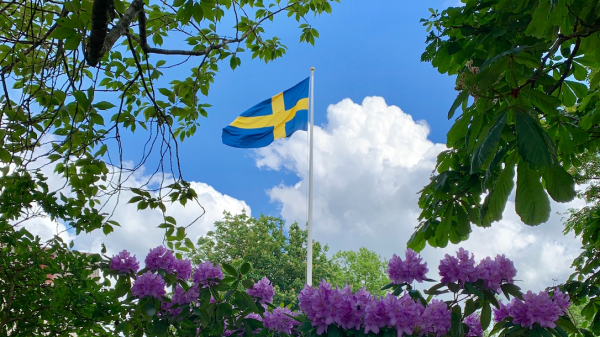
Becoming a Swedish citizen

Photo by Drahomír Posteby-Mach on Unsplash

My journey began sometime around March 2013. I was having lunch at one of my favorite haunts on Sankt Eriksgatan with a good colleague of mine. Joe (not his real name) is from Australia, and at that time, we were both working at a content agency. We share a love of technology and the written word but are deeply divided on the topic of cricket.

Joe and I were sitting at one of those bar-type long benches in the window of the restaurant. Outside, the sun was strong and low, throwing a spotlight on the grit and grime that the winter leaves behind on the streets of Stockholm. The passing cars sent plumes of dirt into the air, and I despaired at thought of all those carcinogenic dust particles.


Joe is incredulous. I’ve completely missed the latest social-media meme — the Harlem Shake — and he simply cannot believe it. I fell into fits of laughter when he showed me the Norwegian Army performing this — now-iconic — dance. Joe’s a bit of a joker, so at first, I thought it was some kind of prank. To this day, if I ever want a laugh, I just take a look at that clip — the dude in the sleeping bag and the guy out to the far left with his snow racer, tube socks, and shower shoes completely crack me up.

It kinda reminded me of the moment I first saw The Hampster Dance. I’m not sure if the Zoomers fully appreciate how ground-breaking this stuff was, my son (15) certainly doesn’t, neither does he get why I find it so funny.

But what do internet memes have to do with becoming a Swedish citizen? At lunch that day, Joe talked about one of the reasons he became a Swedish citizen. He wanted to be able to vote, and specifically to be able to vote against ultra-right-wing fascism that was on the rise in Sweden at the time.

Back then, I didn’t feel any need to become Swedish. As an Irish citizen, I felt I had as much freedom and I didn’t need any special permits to work in Sweden. I felt somehow distanced from the idea. But, over the years, the seed Joe sowed in my brain started to grow.

The rise of right-wing politics

In 2010, about two and half years before the lunch with Joe, the Sweden Democrats (Sverigedemokraterna) (SD) — the fascists Joe was on about — won their first seats in government, earning 5.7% of the votes and 20 of the 349 mandates.

In Sweden, you not only have to win your seat, but you also have to win at least 4% of the entire vote to be granted entrance to parliament. When I first moved here, I thought this idea was odd, almost undemocratic. I’ve now lived here for more than two decades, and like most of the stuff I found weird in the beginning, I have now gotten used to. Today, the idea of a 4% minimum seems smart. It prevents local celebrities from getting voted in and holding national governments to ransom. The likes of the Healy-Rae’s in Co. Kerry, for example, and their decades of conflict-of-interest, which I feel is an embarrassment to Irish politics.


In the 2014 election, SD won 49 seats. And in September 2018, they increased to 62, becoming the third-largest party in the Swedish government.  


In early 2018, while I was researching content for this article, repealing the 8th has nothing to do with abortion, it dawned on me that my emigration from Ireland had basically left me without a voice.

Irish citizens, who’ve lived abroad for more than 18 months cannot vote in local or national elections. But, as I found out, neither can they vote in a referendum.

The rules vary across the EU. French citizens, for example, retain their full voting rights when living abroad. Swedes living in another EU country retain their voting rights for national elections but have to renew their electoral roll registration every 10 years.

And so, in April of 2018, I applied for Swedish citizenship.

I’ve heard horror stories of people waiting years and I’ve heard lighthearted tales of people waiting a few days or weeks for the process to complete. At the time, one of my colleagues — a beautiful Russian lady — had just applied. She got her citizenship in just six weeks. Emboldened by her success, I filled out the forms, sent in my passport, and began to wait.

At the time, the number of cases awaiting decision was about the same as the number of decisions that had been made within the previous 12 months. I figured worst-case scenario was about 18 months tops. Within a couple of weeks, my passport came back, and I decided the best thing to do was to forget about it.

In August 2020, after more than two years in line, I figured I’d waited long enough.

But before going into battle with the Swedish Migration Agency, I thought it might be a good idea to arm myself with some facts, so I asked around for information. I wanted people in a similar situation to me — an EU citizen who had applied for Swedish citizenship within the previous three years — to tell me how long they’d been waiting.

I was surprised at being able to group people into roughly three categories:

The Brits

It seemed anyone with a British passport was getting prioritized. Given the timing, I can only assume this was due to Brexit. A former colleague of mine applied during the summer of 2020. It took six weeks for his application to complete — he told me it could have been faster, but his handler had been on vacation for a month. And of all the British citizens who responded to me, their stories were fairly similar. Most people waited somewhere between a couple of weeks and a couple of months — with the max at around six months.

People with kids

Then there were people who had kids attached to their applications (not literally). That group seemed to wait about one to two years.

Don’t get me wrong, I think it’s good that the system isn’t a blind first-in-first-out process, because some people need protection.

The odd ones

And then there’s my group — the people who on paper don’t seem to need to become Swedish — apart from the not so obvious reason of keeping fascists out of government. The responses I received from people in this group ranged between two years and 30 months, with one girl waiting almost three years.

Force a decision after six months

In August of last year, one of my American friends, who has also been through the process, told me about a service offered by the Swedish Migration Agency to force a decision — a service they provide if you’ve been waiting more than six months. So, I called them up. And after holding for about an hour, I finally got to speak to a handler. He explained the process and then he absolutely floored me. He said that if I applied to force a decision, I would be denied. I was absolutely flummoxed. Why provide a service that’s going to result in a blank denial? Why waste time that could be spent handling applications? And sure enough, six weeks after I put in my request, I received a letter saying that my request had been denied because — and I quote — they didn’t have time to process it.

Seriously, WTF!!! You’ve been sitting on my application for two and a half years.

I was given three weeks to appeal, but at that point, I had honestly lost all desire to become Swedish, and for a fleeting moment, I gave way to the idea that if I’d ever be given the chance, I might actually vote for those right-wing fascists after all.

Shortly before Christmas 2020, I received a new letter from the Swedish Migration Agency asking me for additional information — they wanted to know who I had been working for, my tax returns, and salary for the previous 5 years (information they could quite easily obtain from the Tax Office). In the initial shock, I thought they were looking for grounds to deport me — what I didn’t fully understand was that my original application for citizenship was still in the queue. The fact that my request to force a decision had been denied was irrelevant.

Today, two years and ten months later, I finally became a Swedish citizen. It feels odd. I will, however, be looking forward to voting in the 2022 election. I can’t say who I will vote for, but I promise you, it won’t be any fascists. Thank you Joe, and to all of you who responded to my questions over the years. 

Summer reading — book number one, Say nothing

Photo by Lukas Eggers on Unsplash

This summer, my love of books, of getting lost in other people’s adventures and lives for days on end was re-kindled. Now a pre-teen, my son no longer demands hours of on-tap attention, and so I found myself with time on my hands to read more than the usual New Yorker article rapidly devoured with coffee. I dove into six books in as many weeks, all of which have touched me in one way or another. It’s been sort of like rediscovering thoughts and feelings where dust mites had taken hold. Therapy of a kind.

Book number one — Say nothing: a true story of murder and memory in Northern Ireland (Random House), by Patrick Radden Keefe (who incidentally also writes for my favorite magazine, The New Yorker).

Say nothing is a tale of the Troubles in Northern Ireland centered around a few hand-picked characters, including the Price Sisters, Gerry Adams, and Brendan Hughes — people who played significant roles in the shaping of events.

Keefe’s storytelling of the fighting, fear, and sensitivities that reigned over the streets of Belfast some forty-odd years ago is gripping. Unlike other books I’ve read about the Troubles, Keefe focuses on his characters, their lives, and emotions. As he recounts their intertwining stories, he makes them feel like your neighbors, people you know and care for. The pages reek with the smell of gunfire and misery. The people in the book are real, as are their testimonies, and the incursions they were involved in. Intertwined with the documentary of his main characters, Keefe unravels a murder-mystery, and provides a discourse on the effects of PSTD, of aging and the human tendency to recall the past in varying versions. The book is a documentary of violence and war, a true crime novel, and a dissertation of human regret. It is the story of the murder of a widowed-mother of ten children and the suffering of generations.

With the benefit of hindsight, Keefe is able to illustrate how people change, how memories alter as we grow older, and how idealism — so bravely fought for by young men and women–takes on a new reality with age. Regrets and remorse set in. I wonder about the radicalization of so many young men and women today, how they will feel decades from now.

Midway through the book, we are transported to London, to the scene of the London car-bombing of 1973. I was seven at the time, living in the heart of the English countryside together with my parents and two older sisters. We lived in a small, tight community. Gossip was rife. Be damned if you stepped out of line — everyone knew your business. Everyone knew who you were. Somewhat like the characters in Keefe’s story, without the violence.

My playground peers regularly asked me
if I had a bomb in my pocket.

Sometimes, in the aftermath of an IRA bombing on mainland Britain, I was completely ostracized, sent to Coventry, as it was called. My friends and classmates would refuse to speak to me or acknowledge my existence. They blamed me for the bombings. I was held accountable for the actions of the IRA. Thankfully, small kids are not capable of maintaining this kind of treatment for more than a couple of hours, but my sisters and I were urged to say nothing — a strong undercurrent and sentiment of the times, which Keefe captures so eloquently.

As I grew up, the playground behavior continued. In the 1990s, I was living in Paris, when another London bombing sparked a similar reaction in a colleague of mine (a woman from a country also torn apart by racial and social discrimination). As an adult, I expected more. A deeper understanding, less immediate judgment. Yet it remained that as an Irishwoman and presumably Roman Catholic these two factors were sufficient to convict me of pro-IRA sentiment. I continued to remain accountable for the actions of the IRA in the eyes of my peers.

Having read Say nothing, I am left wondering about the impressionable teenager version of me who possessed a desperate desire to belong. Had I been born of Belfast parents, would I too have looked to the Price sisters as idols and in some way got caught up in the armed struggle? Would I too have been radicalized? An act that with age, motherhood, and responsibility I know I would have regretted, or perhaps not survived to experience regret.

Thank you, Patrick Radden Keefe, for your storytelling, for writing a book that reminds us of the sadness and human suffering brought on by a war whose pain lingers on. Its arrival is timely because my country hasn’t recovered. Peace is delicate and the prospect of a re-instated border in Ireland is already causing unrest. I do not wish for my son–or any child–to live or witness the hell you describe. Say nothing, okay. But do something, at least read this book.

Repealing the 8th has nothing to do with abortion!

Photo by Mohammed Hijas on Unsplash

Repealing Ireland’s Eighth amendment is about removing decades of oppression Irish women and children have endured at the hands of the Catholic Church and the Irish State. Without retribution nor a conscience, these two institutions have systematically kept women at a disadvantage and sold and abused our children. Repealing the Eighth is a small, but vital, step toward unravelling the damage caused by years of lies, deceit, and denial.

In the early summer of 1982, just as I was about to turn 15, my classmates and I were sitting our Inter-Cert exams. Education systems vary across the globe, but back then, this set of state examinations were the first formal tests high-school kids in Ireland sat. Typically characterized by weeks of cramming while the sun is shining, tears, fears, late nights, the hopes for certain essay questions, mathematical proofs, and the dreams of being able to pull off a good still-life against the clock.

Of the two weeks or so the exams continue, one day sticks out, with a memory that nags at my conscience — the day of the music exam. I was my usual nervy self, particularly concerned about my ability to recognize a given piece of music when it was played. In those days, we didn’t have the technology to listen to the works of Bach on repeat — scratched LPs played on a turntable were our only exposure to the music we were supposed to know by heart.

Sitting in the back of the music room were a handful of girls around my age who weren’t from our school. They were sitting the exams just like me, seemingly nervous, just like I was.

The only visible difference between me and these other teenagers, was that each one of them was somewhere between five and nine months pregnant. The vision of one girl in particular still haunts me. She looked like she was wearing a nightdress, heavily pregnant and seemed to be in pain. I wondered how she could sit, let alone focus on the obscure tones of Claude Debussy.

Us local school kids had been instructed not to look, not to engage, not to talk. I refuse to repeat the words that were bandied around, disgusting words used to describe these young women. Heinous clichés uttered by the very nuns who were supposed to be taking care of these of young vulnerable girls, many abandoned by their families. The fear in my soul that day ensured that I didn’t talk to any of them, I too, like everyone else in Ireland, turned my back.

To all of you young girls who experienced this torture, in this case at the hands of the nuns of the Good (seriously) Shepherd Convent in Dunboyne, I hang my head in shame. I am sorry for not showing you the shred of decency that remained locked inside of me.

Repealing the Eighth is about removing those chains of fear.

Fear served as the insurance policy for the nuns and the priests of Ireland and the barbaric institution they belong to. Fear was the mechanism ensuring people were kept in their places. It ensured that my newly-widowed grandmother paid her dues to the church. She worked three jobs to feed and clothe five children. Yet the church saw fit to take her money to ensure her husband’s name was mentioned during the service on Sunday — knowing she feared the scorn of her neighbors more than an empty dinner table.

We lived in an era of self-perpetuating damnation. Starting with the church ensuring that State opposition to contraceptives — not even condoms — remained firm. The sense of shame, preached from the altar, causing parents to abandon their own children into the ‘care’ of mother-and-baby-homes. That we could even call these centers of horror as such makes me weep. The enslavement of women, baby-making machines, who once married were no longer welcome into the workplace. The fear of excommunication for getting an education at my own Alma Mater, Trinity College Dublin. All providing the church with a constant flow of children to abuse and pregnant young women whose babies could be sold. And so it went on.

While international media was sobbing over the tragic case of Ann Lovett (15) who died shortly after giving birth in a field, my English teacher/preacher Sr. Anna (who incidentally worked at the Dunboyne institution), reminded us what of happens to young girls. No compassion for a young girl’s dilemma. Just pure damnation! Right on the back of the abortion referendum, which brought the Eighth into existence, you might wonder what we were thinking back then — I was unfortunately too young to vote at the time. But as is often the case with Irish politics, the facts were muddled with emotions, women were hailed as murderers and witches, and the poor innocent babies — yes, the poor innocent babies that the church would no longer be able to sell if people had a choice.

This referendum is not about abortion, it is not about the rights of the unborn child, it is not about what you believe in or what you don’t. It’s not even about providing women with the freedom to decide over their own bodies. This referendum is about removing the shackles of fear that the church and the Irish State have used to keep Ireland’s women and children enslaved.

Save the date, be sure to vote. Repeal the Eighth.

Blog at WordPress.com.

Up ↑